Important changes to passport regulations

In order to prevent unsuitable horses entering the food chain and to improve the identification of horses, the summer of 2009 saw the introduction of new regulations for horse passports. The regulations came into effect on 1st July 2009 and apply to all European Union member states.

Passports
To comply with current passport regulations it is important that your passport is up to date and the owner details are correct. The correct passports have a number of different sections in which different information is recorded. For example sections I, II and III are concerned with details of the horse and ownership; sections V and IV record vaccines and section IX concerns the use of medicines (more on this later).

If you are not sure your passport is right check it has a section IX under which, part II should read ???I the owner declare that the animal described in this identification document is not intended for slaughter for human consumption.??? If you read this the passport is good.

Microchipping
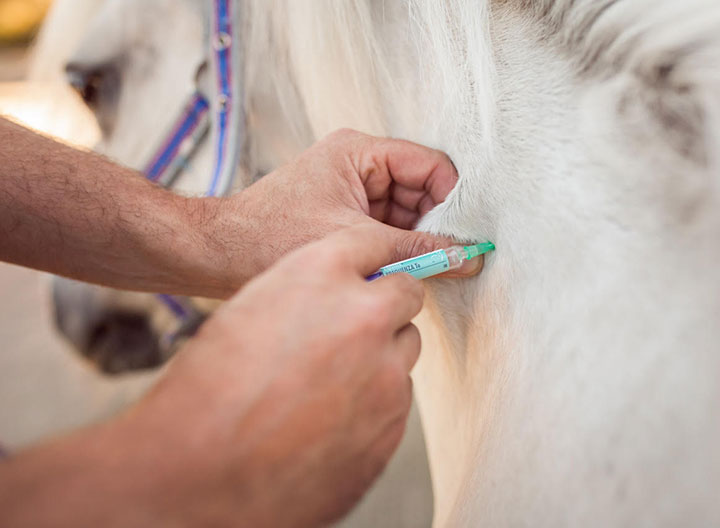
For all new passports, microchipping is now mandatory. The microchip can only be implanted by a veterinary surgeon who must follow strict guidelines. Prior to implantation the vet must carefully scan the neck (microchips are always inserted in the left side of the neck) to check that the horse has not been previously microchipped. If a microchip is found a new chip cannot be inserted and the National Equine Database must be informed who will investigate for a previously issued passport.

If a passport is traced the original Passport Issuing Authority (PIO) will issue a duplicate, if not a ‘replacement‘ new passport may be issued.

The microchip is about the size of a grain of rice and is inserted through the skin via a specially designed applicator. The process is quick and very well tolerated. Microchipping will transform the identification of horses as it gives every animal a unique 15 digit number with a permanent link to its passport.

Medicine regulations
The accurate identification of horses is now more important than ever following new EU laws concerning the use of medicines. Under EU law horses are now considered to be food producing animals so there are new restrictions concerning the types of medicines that can now be administered to horses. Similar legislation has governed the use of medicines in farm animals for years.

Put simply, the legislation is designed to protect the public from drugs that may prove harmful if the horse was to enter the human food chain. Some drugs that have been used commonly in horses ,such as ‘bute‘, are not considered safe to use in animals destined for human consumption.

We are still able to use ‘bute‘ in horses but certain criteria must be met. A horse can now only be administered bute (and other drugs not licensed in food producing animals) if the passport for that animal states that it will never enter the human food chain. This is indicated by signing the declaration in part II of section IX of the passport which states that the animal is not suitable for human consumption.

If part II of section IX of the passport is not completed only medicines that are licensed for food producing animals may be used. In these cases part IIIA of section IX must be completed that states that at some point in the future the animal identified in the passport may enter the food chain. In addition any medicines administered to this animal must be recorded in part IIIB of the passport, the recording of medicines is the responsibility of the owner.

Once part II of section IX of a passport is signed the horse can never enter the food chain and this decision cannot be reversed. It is easy to see how important microchipping is, as it permanently links the horse to its passport and therefore its section IX status.

Any adult horses applying for a new passport will have part II of section IX signed by the passport issuing authority as, because it‘s previous medical history is unknown it cannot be guaranteed safe to enter the food chain.

Together at all times
The new legislations state that the passport must accompany the horse at all times. There are exceptions, for example a horse grazing away from home, but as a general rule the person responsible for the horse must have access to the passport within 3 hours. This includes horses at livery yards, away for schooling and at stud.

From a practical point of view we need to see the passport before we can treat your horse. Remember it is now against the law for us to administer certain drugs if we do not know the section IX status of your horse. If we cannot see the passport we can still treat your horse but we will be restricted in the choice of medicines we can use.

The new legislation need not affect the way in which we treat your horse but it does mean we need free access to your horses‘ passport. Help us to help you in 2010 by having your passport with you at any vet visit.

If you have any queries regarding the new regulations telephone the practice on 01782 510 502.